English
 Deutsch
 Português
Discussing Structural Proposals by Theoretical and Experimental NMR.
Results shown
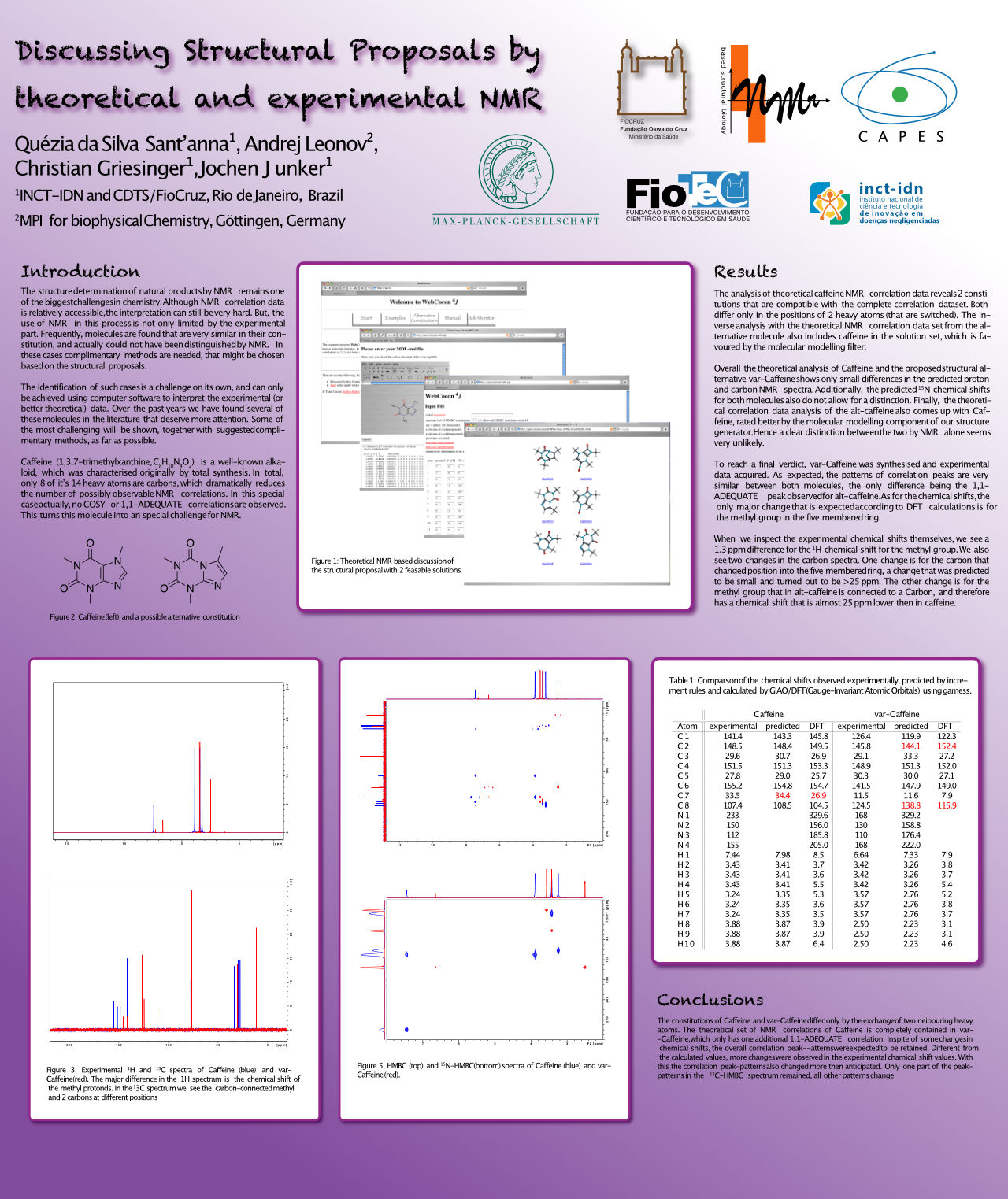
The structure determination of natural products by NMR remains one of the biggest challenges in chemistry. Although NMR correlation data is relatively accessible, the interpretation can still be very hard. But, the use of NMR in this process is not only limited by the experimental part. Frequently, molecules are found that are very similar in their constitution, and actually could not have been distinguished by NMR. In these cases complimentary methods are needed, that might be chosen based on the structural proposals.
The identification of such cases is a challenge on its own, and can only be achieved using computer software to interpret the experimental (or better theoretical) data. Over the past years we have found several of these molecules in the literature that deserve more attention. Some of the most challenging will be shown, together with suggested complimentary methods, as far as possible.
Caffeine (1,3,7-trimethylxanthine, C8H10N4O2) is a well-known alkaloid, which was characterised originally by total synthesis. In total, only 8 of it’s 14 heavy atoms are carbons, which dramatically reduces the number of possibly observable NMR correlations. In this special case actually, no COSY or 1,1-ADEQUATE correlations are observed. This turns this molecule into an special challenge for NMR.
The analysis of theoretical caffeine NMR correlation data reveals 2 constitutions that are compatible with the complete correlation dataset. Both differ only in the positions of 2 heavy atoms (that are switched). The inverse analysis with the theoretical NMR correlation data set from the alternative molecule also includes caffeine in the solution set, which is favoured by the molecular modelling filter.
Overall the theoretical analysis of caffeine and the proposed structural alternative alt-caffeine shows only small differences in the predicted proton and carbon NMR spectra. Additionally, the predicted 15N chemical shifts for both molecules also do not allow for a distinction. Finally, the theoretical correlation data analysis of the alt-caffeine also comes up with caffeine, rated better by the molecular modelling component of our structure generator. Hence a clear distinction between the two by NMR alone seems very unlikely.
To reach a final verdict, alt-caffeine was synthesised and experimental data acquired. As expected, the patterns of correlation peaks are very similar between both molecules, the only difference being the 1,1-ADEQUATE peak observed for alt-caffeine. As for the chemical shifts, the only major change that is expected according to DFT calculations is for the methyl group in the five membered ring.
When we inspect the experimental chemical shifts themselves, we see a 1.3 ppm difference for the 1H chemical shift for the methyl group. We also see two changes in the carbon spectra. One change is for the carbon that changed position into the five membered ring, a change that was predicted to be small and turned out to be >25 ppm. The other change is for the methyl group that in alt-caffeine is connected to a Carbon, and therefore has a chemical shift that is almost 25 ppm lower then in caffeine.
Literature cited
The following literature references are used for this poster:
The Poster