English
 Deutsch
 Português
WebCocon: From Correlations to Constitutions in the WWW.
Results shown
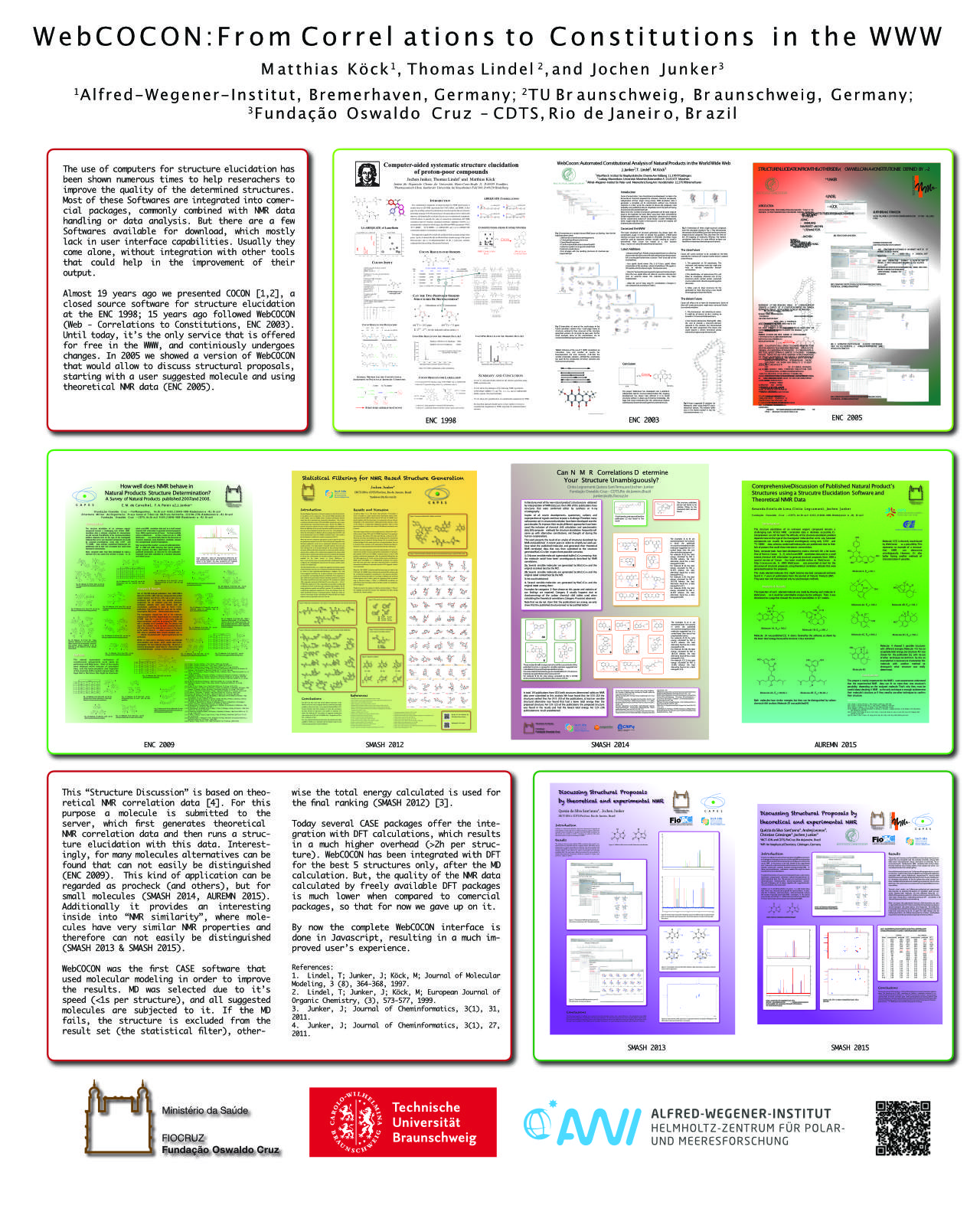
The use of computers for structure elucidation has been shown numerous times to help reserachers to improve the quality of the determined structures. Most of these Softwares are integrated into comercial packages, commonly combined with NMR data handling or data analysis. But there are a few Softwares available for download, which mostly lack in user interface capabilities. Usually they come alone, without integration with other tools that could help in the improvement of their output.
Almost 15 years ago we presented WebCocon (Web - Correlations to Constitutions), which is based on Cocon [1,2], a closed source software for structure elucidation. Until today, it’s the only service that is offered for free in the WWW, and continiously undergoes changes. It was the first CASE software that used molecular modeling in order to improve the results. MD was selected due to it’s speed (<1s per structure), and all suggested molecules are subjected to it. If the MD fails, the structure is excluded from the result set (our statistical filter), otherwise the total energy calculated is used for the final ranking [3].
Today several CASE packages offer the integration with DFT calculations, which results in a much higher overhead (>2h per structure). WebCocon has been integrated with DFT for the best 5 structures only, after the MD calculation. But, the quality of the NMR data calculated by freely available DFT packages is much lower when compared to comercial packages, so that for now we gave up on it.
From early on WebCocon offered a unique feature: “Structure Discussion” based on theoretical NMR correlation data [4]. For this purpose a molecule is submitted to the server, which first generates theoretical NMR correlation data and then runs a structure elucidation with this data. Interestingly, for many molecules alternatives can be found that can not easily be distinguished. This kind of application can be regarded as procheck (and others), but for small molecules.
By now the complete WebCocon interface is done in Javascript, resulting in a much improved user’s experience.
Literature cited
The following literature references are used for this poster:
- Lindel, T; Junker, J; Köck, M; Journal of Molecular Modeling, 3 (8), 364-368, 1997.
- Lindel, T; Junker, J; Köck, M; European Journal of Organic Chemistry, (3), 573-577, 1999.
- Junker, J; Journal of Cheminformatics, 3(1), 31, 2011.
- Junker, J; Journal of Cheminformatics, 3(1), 27, 2011.
The Poster