English
 Deutsch
 Português
1H Chemical Shift Variations in complex Mixtures at different Concentrations.
Results shown
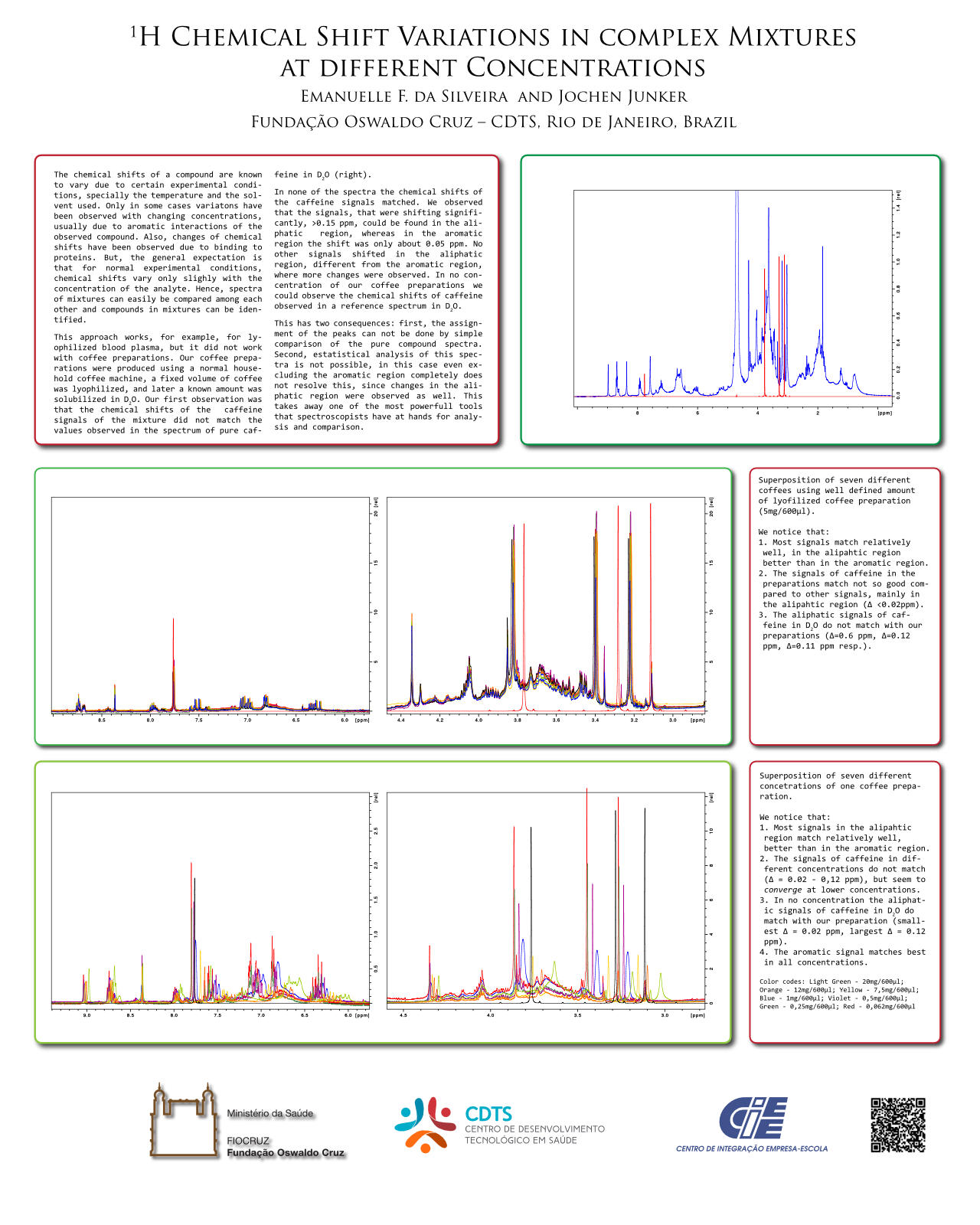
The chemical shifts of a compound are known to vary due to certain experimental conditions, specially the temperature and the solvent used. Only in some cases variatons have been observed with changing concentrations, usually due to aromatic interactions of the observed compound. Also, changes of chemical shifts have been observed due to binding to proteins. But, the general expectation is that for normal experimental conditions, chemical shifts vary only slighly with the concentration of the analyte. Hence, spectra of mixtures can easily be compared among each other and compounds in mixtures can be identified.
This approach works, for example, for lyophilized blood plasma, but it did not work with coffee preparations. Our coffee preparations were produced using a normal household coffee machine, a fixed volume of coffee was lyophilized, and later a known amount was solubilized in D2O. Our first observation was that the chemical shifts of the caffeine signals of the mixture did not match the values observed in the spectrum of pure caffeine in D2O. Next we aquired NMR spectra with varrying concentrations.
In none of the spectra the chemical shifts of the caffeine signals matched. We observed that the signals that were shifting significantly, >0.15 ppm, could be found in the aliphatic region, whereas in the aromatic region the shift was only about 0.05 ppm. No other signals shifted in the aliphatic region, different from the aromatic region, where more changes were observed. In no concentration of our coffee preparations we could observe the chemical shifts of caffeine observed in a reference spectrum in D2O.
This has two consequences: first, the assignment of the peaks can not be done by simple comparison of the pure compound spectra. Second, estatistical analysis of this spectra is not possible, in this case even excluding the aromatic region completely does not resolve this, since changes in the aliphatic region were observed as well. This takes away one of the most powerfull tools that spectroscopists have at hands for analysis and comparison.
Literature cited
The following literature references are used for this poster:
The Poster